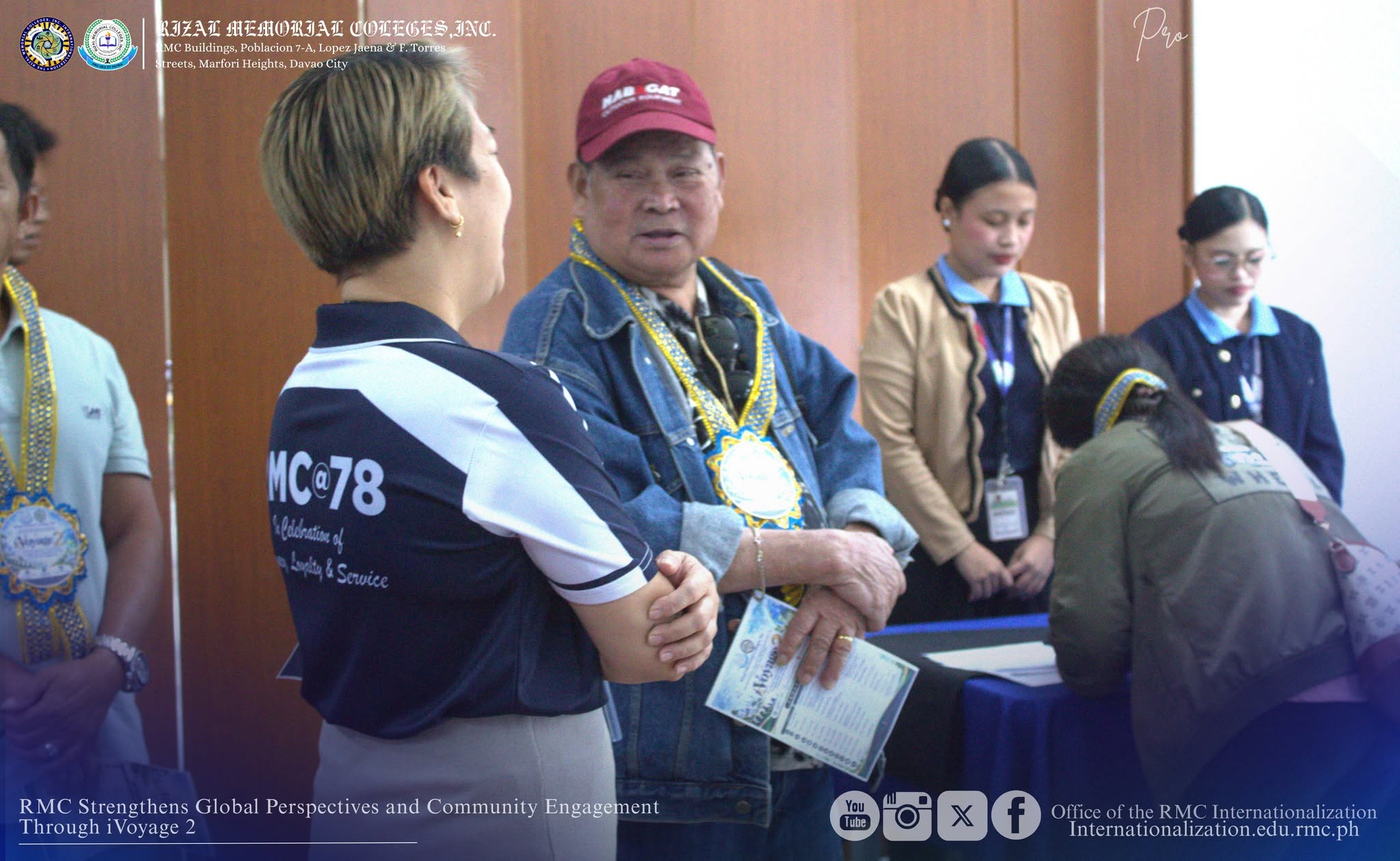
DAVAO CITY, Philippines — Rizal Memorial Colleges, Inc. (RMC), through the Internationalization Affairs and Linkages Office (IALO), in partnership with the Community Extension Office, successfully conducted iVoyage 2 on October 2, 2026, at the RMC La Liga Hall, carrying the theme “Global Perspectives, Local Impact: Strengthening Communities through Extension and Engagement.”
The institutional initiative highlighted the integration of international perspectives into local community development, reinforcing the College’s commitment to meaningful partnerships, sustainable development, and socially responsive education. The activity also served as a platform for strengthening collaboration among academic leaders, faculty members, students, international resource speakers, and local community partners.
The program commenced with opening remarks delivered by Prof. Cristina Ariate, Head of the Community Extension Office, who emphasized the significance of collaborative engagement in addressing community needs and fostering sustainable institutional partnerships.
This was followed by an inspirational message from Dr. Gel Marie B. Tiboron, Vice President for Academic Affairs, underscoring the importance of advancing academic excellence alongside social responsibility, institutional collaboration, and community empowerment.
Meanwhile, Prof. Antonio A. Solomon Jr., Director of Internationalization Affairs and Linkages, formally introduced iVoyage 2 and its resource speakers, highlighting the initiative’s role in bridging international knowledge and local practices. The activity reflected the institution’s continuing efforts to advance internationalization at home by bringing global insights into accessible learning environments while connecting these perspectives to community extension and development.
The program featured two international resource speakers, Emmelie Lou C. Davidson and Timothy Davidson, who shared perspectives relevant to community engagement, collaborative development, and the importance of connecting broader global experiences with local initiatives. Their participation contributed to the program’s objective of encouraging participants to recognize the value of international perspectives in developing sustainable and community-centered approaches.
A significant highlight of the activity was the participation of RMC’s local community partners, whose presence reinforced the institution’s commitment to maintaining meaningful relationships with communities beyond the academic setting.
Among the invited community representatives were Barangay Captain Rolando L. Mansi, Elizabeth P. Engay, Maria Jane L. Duyan, and Jovy E. Alig. Their participation emphasized the vital role of community stakeholders in institutional extension initiatives, particularly in ensuring that educational programs and international collaborations remain responsive to actual community needs, local realities, and shared development priorities.
The engagement of community representatives further demonstrated that internationalization extends beyond cross-border academic exchanges. It also encompasses the meaningful application of international knowledge, experiences, and collaborative practices to strengthen local communities and promote inclusive development.
Following the presentations, an open forum provided participants with opportunities to engage with the resource speakers, exchange perspectives, and reflect on the practical applications of the discussions.
During the synthesis session, Dr. Agnes P. Mascariñas, Dean of the College of Teacher Education, consolidated the significant insights and key learning points of the activity, emphasizing the importance of transforming shared knowledge into meaningful educational practices and community-oriented initiatives. The synthesis reinforced the responsibility of academic institutions to translate professional learning and collaborative engagement into concrete contributions to community development.
Representing the student body, Kelvin King R. Aradillos, President of the Supreme Student Government (SSG), also delivered a synthesis from the students’ perspective, highlighting the relevance of the activity to student participation, civic responsibility, and awareness of the relationship between global understanding and local community engagement.
The inclusion of both academic leadership and student representation during the synthesis reflected the institution’s commitment to inclusive learning, participatory engagement, and the recognition of students as important stakeholders in community development and internationalization initiatives.
The activity concluded with the awarding of certificates, a photo opportunity, and closing remarks delivered by Dr. Alminda M. Fernandez, Director of Research and Planning Development, formally concluding the program and reinforcing the significance of sustaining meaningful institutional collaborations.
Aligned with the principles of Commission on Higher Education (CHED) Memorandum Order No. 55, Series of 2016, or the Policy Framework and Strategies on the Internationalization of Philippine Higher Education, iVoyage 2 contributed to the institution’s continuing efforts to integrate international and intercultural dimensions into its academic and community engagement functions.
Moreover, the initiative supported the United Nations Sustainable Development Goals, particularly SDG 4 (Quality Education), SDG 11 (Sustainable Cities and Communities), and SDG 17 (Partnerships for the Goals), by promoting inclusive learning opportunities, strengthening community participation, and fostering partnerships toward sustainable development.
Through iVoyage 2, Rizal Memorial Colleges, Inc. reaffirmed that internationalization is not solely defined by international mobility or institutional agreements but also by the capacity to transform global knowledge into meaningful local action.
The successful conduct of the activity reflected the collaborative efforts of the Internationalization Affairs and Linkages Office and the Community Extension Office in advancing a shared institutional vision in which global perspectives inspire local solutions, partnerships empower communities, and education becomes a catalyst for sustainable transformation.
Guided by its enduring institutional philosophy, Pro Deo et Patria — For God and Country, RMC continues to strengthen the connection between international engagement, academic excellence, and community service.